












Bedside cribs: how to choose one and set it up safely

Nov
Keeping baby close to you at night without having them sleep in your bed: that’s the whole point of a bedside crib. But with all the different sizes, heights and attachment systems, it isn’t always easy to know which one to choose, or how to set it up. In this article, I explain what to look for before buying, the mistake to avoid when you get home from the maternity ward, and the rules for setting it up safely.
Le cododo, c’est quoi exactement ?
A bedside crib is a small bed that attaches to your bed, on its open side. So baby sleeps in their own bed, but right next to you. This is exactly what the Assurance Maladie (French national health insurance) recommends: having baby sleep in their own bed, in the parents’ room until 6 months, but without sharing the parents’ bed.
And day to day, it really makes life easier! Once the bedside crib is against your bed, nothing separates you from baby any more. So in the middle of the night, you can pick them up without even getting up: to breastfeed, for example, or to give them a cuddle when they cry. Then you simply lay them back down in their bed, within arm’s reach.
Beware of bedside cribs that are too big
This is the mistake I see most often. In their mum’s tummy, baby lived in a tiny space, always in contact with something. So at birth, it’s quite a shock: suddenly, there’s space all around them!
You may have noticed: in the maternity ward, the cribs are tiny. That isn’t to save space. It’s mainly because baby touches the sides with their hands, and that reassures them. If, on the other hand, you put them in a big crib or a big bedside crib as soon as you get home, they lose those reference points. The result: they are likely to cry much more often.
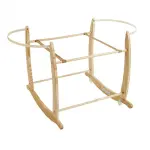
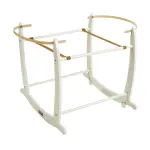
That’s why, for the first few weeks, choose a narrow bedside crib that keeps that cocoon feel. And if your bedside crib is large, start with a Moses basket next to your bed instead. Above all, never add a cot reducer: it is dangerous for babies, as I explain in Cot reducers: are they dangerous for babies?.
Choosing the right bedside crib: 4 criteria
1. The safety standard
A bedside crib must comply with the European standard EN 1130, which sets out precise safety criteria for manufacturers. This information is always given in the product description: if you can’t find it, move on.
2. Compatibility with your bed
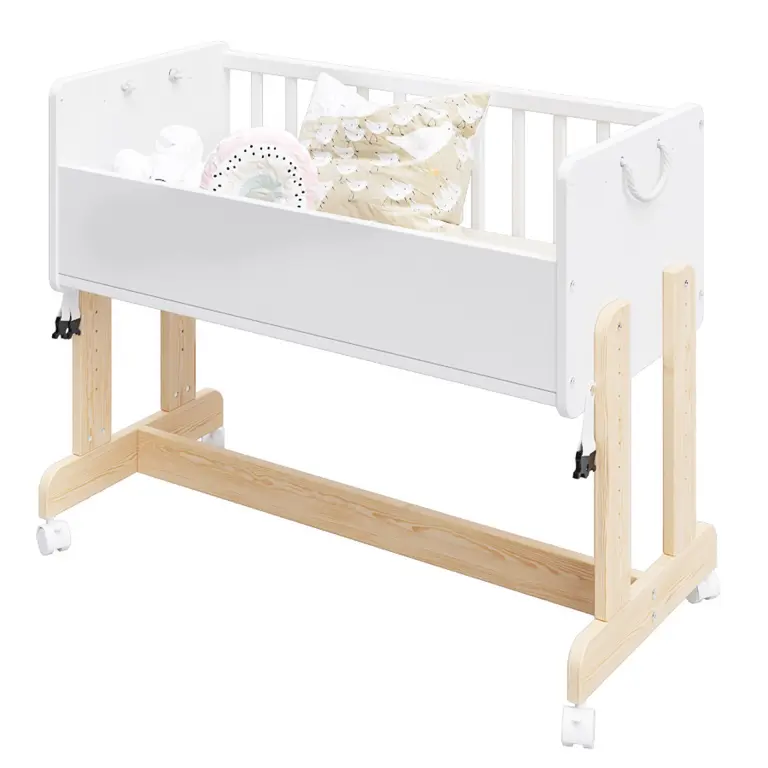
Measure the height of your bed, including the mattress, before you buy. The bedside crib must be adjustable so that its mattress is at the same height as yours. For example, our Ornella crib fits beds from 33.7 to 62.5 cm high, and the BabyBay Original from 12 to 52.5 cm.
3. A sturdy attachment system
The bedside crib must be securely attached to your bed, using a system provided by the manufacturer. That way, it can’t move away during the night.
4. Think long term
A bedside crib is used for around six to nine months. So to avoid putting it in the loft too soon, choose a model that converts afterwards: into a bench, a desk or a toy chest.
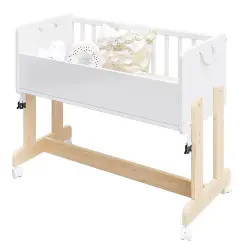
👉 Our Ornella 5-in-1 bedside crib, with its 90×40 cm mattress included, converts into a desk that grows with your child, a bench or a toy chest. Its small size lets baby stay in contact with the sides. And the BabyBay Original, in solid beech, can be used until around 9 months before becoming a bench or a desk. Both are made in Europe. Discover all our bedside cribs.
Setting up the bedside crib safely
Once you’ve chosen your bedside crib, here are the golden rules for setting it up:
- Mattress at the same height as yours, and the bedside crib firmly attached to your bed, so that no gap forms between the two.
- A firm mattress of the right size: as the Assurance Maladie points out, it must leave no gap that baby could slip into.
- Nothing in the bed: no cot bumper, no pillow, no duvet or blanket. Use a baby sleeping bag instead.
- Always on their back: lay baby down on their back, flat, at night as well as for naps.
- Everyone in their own bed: if you take baby into your bed to feed them, put them back in their bedside crib before you go back to sleep.
Finally, think about suitable bedding: a fitted sheet that fits the mattress snugly, like our organic cotton 40×90 cm fitted sheets.
Your questions about bedside cribs
Until what age can you use a bedside crib?
Generally until 6 to 9 months, depending on the model and baby’s size. Always follow the manufacturer’s instructions.
Bedside crib or Moses basket: which should you choose?
Both keep baby close to you. The Moses basket, being narrower, is especially reassuring for newborns and can go anywhere in the house with you. The bedside crib keeps baby right next to you at night. To compare, read Moses basket, bedside crib or cot: how to choose your baby’s bed.
Can you put a cot bumper in a bedside crib?
No. The Assurance Maladie advises against cot bumpers: there should be nothing soft around baby.
Dylan
Proud dad of three little ones and founder of Premiers Moments. Together with the whole team, I share our parenting tips here to support you, from pregnancy through your child's first years.
Discover our nursery furniture