













Everything you need to know about pregnancy tests

Feb
Reliable and quick, the urine pregnancy test lets you find out whether you're pregnant. But how does it work? What should I do if I'm pregnant?
How does a pregnancy test work?
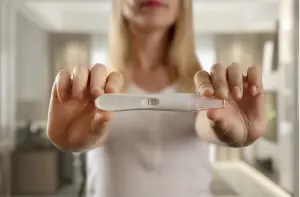
A urine pregnancy test detects the presence of the hormone beta-hCG in urine. This hormone, known as the pregnancy hormone, appears in the body from fertilisation. However, it can only be detected by a pregnancy test from the 8th day after fertilisation, and it rises sharply during the first trimester of pregnancy. But how does it work? Pregnancy tests are single-use and all work in more or less the same way. Simply place the tester in a container of urine or under the stream of urine. Then, depending on the test, you will need to wait 1, 3 or 5 minutes for the result. Some pregnancy tests show a positive result (pregnant) with two lines of varying colour or “+ +” signs. Others clearly display “PREGNANT”. If the result is negative (not pregnant), you will see a single coloured line, the “–” sign or the words “NOT PREGNANT” respectively.
A pregnancy test bought in a supermarket or pharmacy costs between €3 and €12 and is not reimbursed by the Sécurité Sociale in France. You can ask for one free of charge at a Planning Familial (family planning) centre near you.
When can you take a pregnancy test?

If you want to know whether you're pregnant, you can take a pregnancy test whenever you like. However, it will be more reliable in the morning. Morning urine, especially the first urine of the day, has a higher concentration of the beta-hCG hormone. So the test is more likely to detect the hormone if you're newly pregnant. If you take it during the day, make sure you haven't drunk too much: the hormone will be less concentrated in your urine and therefore harder for the test to detect. For the test to work properly, your beta-hCG level needs to be detectable by the test. So there's no point taking the test straight after intercourse. Wait instead until 3-4 days after your period was due. There's nothing more you need to know about pregnancy tests: they're quick to do and you can find them in pharmacies and supermarkets. If you don't know which pregnancy test to choose, you can always ask your pharmacist for advice.
The possible results, and what next?

As you'll have gathered, there are two possible results at the end of the test: negative (not pregnant) or positive (pregnant). What's more, today's tests are 99% reliable. “False positives” are very rare, as are “false negatives”.
-
My result is negative (not pregnant)
If this is your first pregnancy test, we recommend taking a second one a week later to be sure of the result. If a pregnancy test is taken too early, the tester cannot detect the beta-hCG hormone because there is probably not enough of it in the urine yet. Within a few days, the level rises sharply (especially in the first days of pregnancy), so repeating the test is useful. If the second test is still negative, then you are not pregnant. Don't forget to read the pregnancy test instructions in full and follow them carefully for more reliable results. You may get a “false negative” (you are pregnant but the test is negative) if, for example, you don't respect the waiting time stated in the instructions.
-
My result is positive (pregnant)
Congratulations, you are pregnant! The next step? Make an appointment with a doctor or a midwife. They will give you a prescription for a blood test as a first check-up. It will also be a chance for the health professionals to find out the level of beta-hCG in your blood and to estimate a due date. This is the start of the great adventure!
However, there are rare cases of “false positives” (you're not pregnant but your test is positive). These are even rarer than “false negatives”. Here are the situations in which you could get a “false positive”:
– Treatment with a medicine containing the beta-hCG hormone.
– Recent pregnancy (recent birth, after a miscarriage or an abortion).
– Rare ovarian cyst
Now pregnancy tests hold no more secrets for you. Whatever your result, you can always make an appointment with a health professional to talk about what comes next. They're not there to judge you: they'll guide you with kindness.
Dylan
Proud dad of three little ones and founder of Premiers Moments. Together with the whole team, I share our parenting tips here to support you, from pregnancy through your child's first years.
Pack baby's hospital bag