Finding the perfect crib for your baby is much more than a simple purchase: it’s about creating a comfortable cocoon that is safe and suited to their first months of life. Between solid wood models, bedside cribs with adjustable height, rattan cribs and folding travel cribs, there are plenty of options… and every parent deserves to make an informed choice.
This product has multiple variants. The options may be chosen on the product page
In our shop, we offer a complete selection of cribs designed to blend harmoniously into your room, offer stable sleep, and meet every need : breathable mattress, castors for moving around, elegant design, or even a rocking function for restless nights.
Whether you are looking for a traditional crib, a convertible bed or a folding crib for travel, our website guides you every step of the way. Discover certified products at the best price, in a style that suits you. Because your child's comfort starts here.
Understanding the role of the crib in baby's first months
The baby crib plays a key role from birth. It provides a sleeping space that is safe, close to the parents, ideal for baby's nights and its daytime naps.
Designed for everyday use, it adapts to the needs of the newborn up to 6 or 9 months. There are solid wood cribs, as well as folding models, and even convertible bedside cribs.
Some models are fitted with castors to make it easier to moving it around. Others offer built-in storage, a quality baby mattress or a breathable fabric.
The crib creates a cosy space, designed for the comfort and safety while they sleep.
It is an essential piece of nursery furniture, to include in any baby registry.
Key points:
Use: from birth to 6–9 months
Position: in the bedroom or as a bedside crib
Purpose: to keep baby safe, reassured and close
Models: white wood, beech bedside crib, affordable crib, designer or convertible
Which type of crib should you choose?
The choice of crib depends on the parents' needs, the space available and the preferred sleeping arrangement. Here are the main types of crib worth knowing about to help you choose a crib suited to your situation.
Classic crib: ideal for the first few weeks, compact and often lightweight, perfect for a nursery.
Convertible crib: adaptable, it grows with your child, turning from a crib into a cot.
Bedside crib: keeps baby within arm's reach, making breastfeeding easier and strengthening the parent–child bond.
Bedside crib with mattress: often sold as a set, it provides a complete, ready-to-use bed.
Wooden crib: sturdy, natural and attractive, often preferred for its durability.
Quality crib: compliant with standards, well ventilated, with a suitable mattress for safe sleep.
Baby crib: a general term covering all models suitable for babies from 0 to 6/9 months.
How to choose a crib mattress
The crib mattress is just as important as the crib itself. To ensure your baby's comfort and safety, you need to choose a mattress suited to their size, their weight and the shape of the bed. A baby mattress should be firm, breathable and perfectly fitted with a crib. It must not leave any gap between the edges of the mattress and its bars. A rectangular mattress is usually the standard shape, but some models require a specific size.
Choose a quality mattress, free from chemical treatments, with a cover that is removable and washable. Models that are breathable or made of high-density foam ensure better air circulation.
Some cribs are sold with an integrated mattress – this is the case for many bedside cribs with a mattress. Always check that the mattress is suitable for the model.
Tip: For a successful purchase, choose a certified mattress, of the right thickness, easy to care for and guaranteed free from harmful substances.
Which accessories do you need for a crib?
An crib is not enough on its own. To make it practical and reassuring, certain accessories are essential.
Start with a light blanket suited to the season. Add a night light for night-time waking. It helps to reassure baby without disturbing them.
Nearby accessible storage space nearby is always useful: for nappies, muslin squares or bottles. Also consider a changing table designed to go with a furniture in the room. It's a small piece of furniture full of common sense that makes everyday life easier.
The baby Moses basket can complement the crib, especially for moving it around. Our complete rocking crib, meanwhile, soothes baby with a gentle rocking motion.
All these items are part of thenursery equipment basics. They create a functional, comfortable and welcoming environment.
To add to your baby registry:
Soft night light
Breathable blanket
Compact changing table
Practical storage space
Moses basket for carrying
Rocking crib if natural movement is needed
How to choose the perfect crib for your baby
The perfect crib for your newborn should combine safety, comfort and practicality. On our website, we offer a complete range of baby cribs, from the convertible bedside crib to models in solid wood, perfect for keeping baby close with complete peace of mind. Each collection is designed to support the growth of your child while adapting to your room layout.
Which technical criteria should guide your choice?
Before making any purchase, check the dimensions, the compatibility with a baby mattress, the ventilation of the bed and the materials used. Our complete white bedside crib or the safe crib made of beech wood with breathable fabric is a good example of a durable solution. Some models are fitted with castors, others offer direct contact with the parents' bed.
Solid wood, metal or rattan crib: which should you choose?
The solid wood crib, often white and beech, remains a perfect choice for its sturdiness and its natural style. Our complete rattan brings a decorative touch that is highly sought after, while metal is lighter and some models are folding, ideal for travel. Each material has its characteristics, its advantages and its preferences depending on the style of your furniture.
From when and until what age should you use a crib?
An baby crib is designed for the first few months, generally up to 6 or 9 months. It depends on the growth of the child and the size of the model chosen. Small cribs are suited to limited use, whereas a comfort bedside crib can be used for longer.
How to choose a crib for twins
For twins, you have two options: a double crib ou deux separate cribs placed side by side. Check the dimensions, the safety, and choose a solution that is easily accessible for the parents.
How to dress baby for a good night's sleep in the crib
Dress baby in a bodysuit and a sleeping bag suited to the temperature of the room. Avoid blankets, hats and pillows. Choose fabrics that are breathable and soft. In summer, opt for light cotton; in winter, choose a baby sleeping bag with a high TOG. The aim: to keep baby warm without overheating.
Crib safety and standards: what you need to check
The comfort of your baby matters, but their safety comes first. To get a good night's sleep, your child needs a stable piece of furniture, compliant with standards and suited to their age. Before completing your purchase in store or on a partner website, always check that the crib you choose complies with the EN 1130 standard, which is mandatory for baby cribs in Europe.
Whether it's a wooden bedside crib or a bedside crib the safety should be clearly stated in the product description. This is non-negotiable, especially for a newborn.
Which standards apply?
EN 1130 standard: guarantees sturdiness, stability and the absence of entrapment risks.
Non-toxic materials, solvent-free paint.
Smooth edges, with no sharp corners or detachable parts.
Height and bar spacing strictly regulated.
Which mistakes should you avoid to ensure safe sleep?
Here is a list of items not to use in a crib, even if they seem decorative or comfortable:
Thick cot bumper or padded bumper
Pillow or cushion
Heavy blanket or one that isn't breathable
Bulky soft toys in the crib
Mattress that is too soft or poorly fitted
All our designer cribs, classic bedside cribs or white comfort models are chosen for their compliance with standards and their suitability for long-lasting family use. Comparing prices, reading reviews, and choosing a product with a fast delivery service is essential to make a furniture choice that is safe and practical.
Recommended crib accessories
Here's what to add (or not) around the designer baby crib. Stick to the essentials. Avoid anything superfluous.
Sheets, mattress protector, canopy holder, mosquito net: essential or not?Suitable fitted sheets: yes
Thin, breathable waterproof mattress protector: yes
Decorative canopy holder: not necessary
Mosquito net: only useful in summer, under supervision
Mobile, night light, cot bumper: beware of risky accessoriesSoft night light : practical for parents
Mobile above the head: risk of suffocation if poorly attached
Thick cot bumper: to be avoided, even from the big brandsMoses basket stand or rocking crib: what are they for?Stand: useful for raising a Moses basket
Gentle rocking: helps baby fall asleep
Furnishing the room with a crib: practical tips
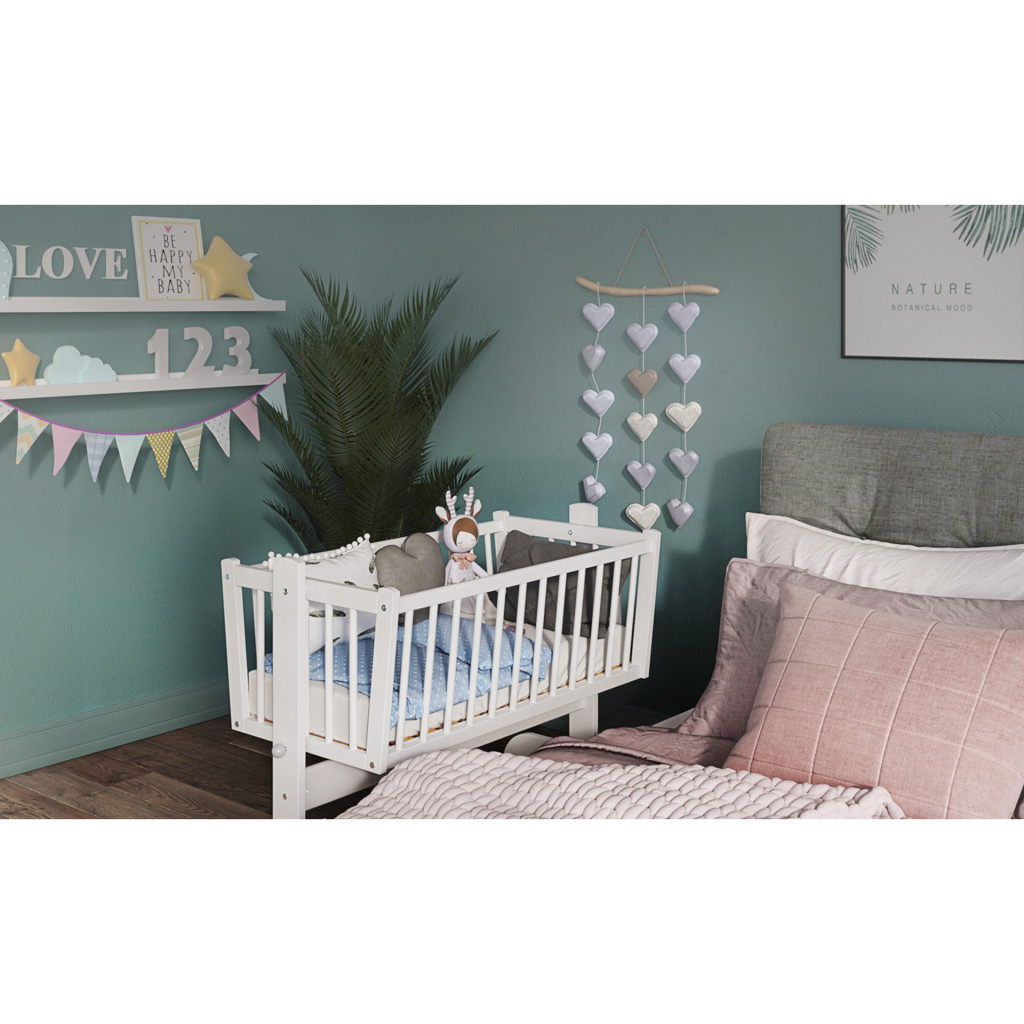
The baby crib should fit naturally into the space. It blends in with the decor while ensuring safe sleep.
Place the bedside crib near the parents' bed. This makes night-time waking easier. Keep clear access on each side. Avoid draughts. Don't put it right against a window. Choose a quiet, temperate and shaded area.
Pair the crib with a small, practical piece of furniture. A compact chest of drawers is enough. Add a changing top if space allows. A nursing chair is a real bonus. It creates a cosy corner for the family.
In terms of style, light wood remains a safe bet. Rattan is making a comeback. Scandinavian white is still popular. Shades of beige, the grey or the graphite are very much on trend. The convertible crib is ideal for saving space. It grows with baby without having to change the whole room. A new partner offer can also include a complete set.
FAQ: answers to the most frequently asked questions
What is the difference between a classic crib and a bedside crib?
The classic crib is free-standing, while the baby bedside crib attaches to the parents' bed for a direct contact.
When should you move from the crib to a cot?
You can move to the cot at around 6 to 9 months, depending on the growth and activity of your child.
Does a breastfed baby need a crib?
Yes, especially a classic bedside crib to make nights easier.
Can I use a travel cot instead?
As a stopgap, yes, but the comfort is not as good as with a convertible crib.
Can you rent a crib or Moses basket?
Yes, this is available in some shops or online.
Is a crib essential from birth?
It isn't compulsory, but it is often what parents prefer for the first few months.




 French
 English
 German
 Spanish
 Italian
 Dutch
 Polish
 Portuguese
 Czech

